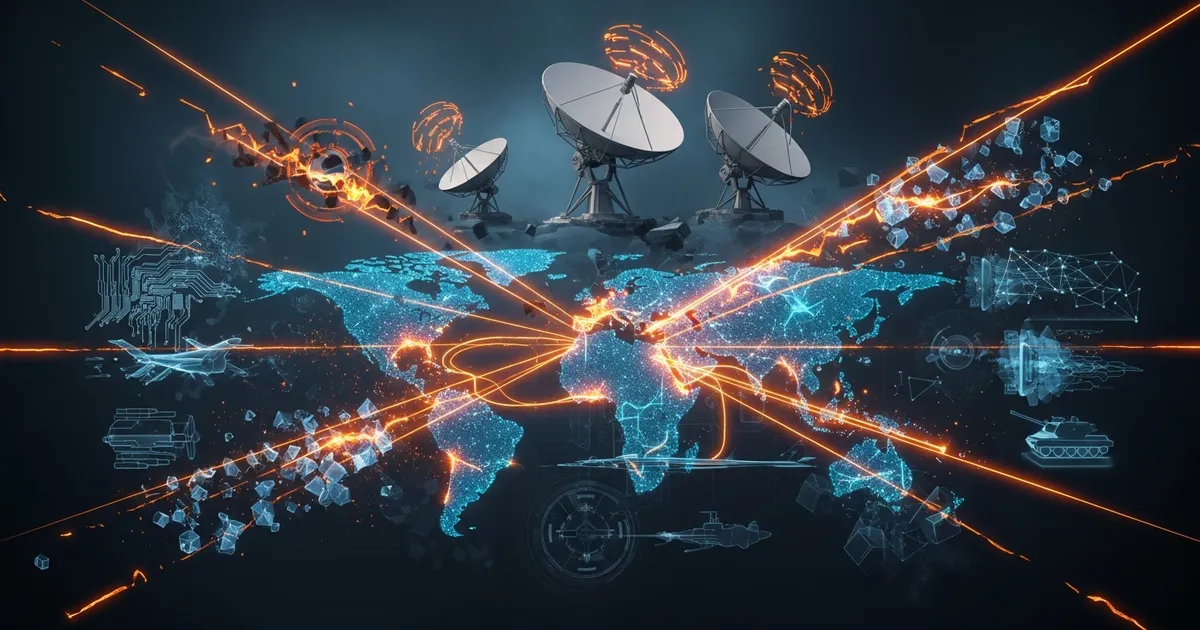
The digital ghost in the machine
Recent claims from Iran about using a new air defense system to target a U.S. fighter jet serve as a stark reminder of the escalating tensions in the Middle East. While such assertions are often shrouded in propaganda and difficult to verify independently, they pull back the curtain on a far more significant and less visible conflict: the convergence of conventional military hardware with sophisticated cyber and electronic warfare (EW). The real story is not just about missiles and jets, but about the code, signals, and data that dictate their every move.
This is not a new theater of operations. The incident echoes Iran's 2011 claim of capturing a U.S. RQ-170 Sentinel stealth drone. At the time, Iranian engineers asserted they had commandeered the drone by spoofing its GPS signals, effectively tricking it into landing on an Iranian runway instead of its home base. While U.S. officials never confirmed the method, the event demonstrated that the digital underpinnings of advanced military assets could be their Achilles' heel. Today, the lines between jamming a radar signal, hacking a command-and-control network, and launching a missile have become dangerously blurred.
The technical battlefield
To understand the threat, one must look beyond the physical hardware and into the digital domain where modern battles are increasingly waged. The act of "targeting" an aircraft is no longer a simple mechanical process; it is a complex, data-driven operation vulnerable to digital interference.
Electronic warfare: The art of deception
Electronic warfare is the foundational layer of this conflict. It operates within the electromagnetic spectrum to disrupt or deceive enemy systems. Key techniques include:
- Jamming: Overwhelming an aircraft's radar or communication systems with noise, effectively blinding it or cutting it off from its operators.
- Spoofing: Transmitting false signals to mislead an enemy system. As seen in the RQ-170 incident, this could involve feeding a drone false GPS coordinates to manipulate its navigation. In the context of an air defense system, spoofing could create phantom targets to waste valuable munitions or make a real aircraft appear to be somewhere it is not.
Modern EW is deeply intertwined with cyber operations. The systems that generate jamming signals or execute spoofing attacks are software-defined, meaning they can potentially be hacked, updated with new attack vectors, or used to deliver malicious code.
Cyber-physical systems under fire
An air defense network is a quintessential cyber-physical system—a complex web of sensors, launchers, command centers, and communication links. This digital infrastructure presents a rich target for state-sponsored attackers. A successful cyberattack could achieve effects far more subtle and devastating than a conventional strike:
- Data Manipulation: An intruder could subtly alter tracking data, causing the system to miscalculate a target's speed, altitude, or trajectory, leading to a missed intercept.
- System Disruption: Malware could be used to disable radar arrays at a critical moment, prevent a missile from launching, or even cause the system to shut down entirely.
- Supply Chain Compromise: One of the most insidious threats involves embedding malicious components or code into hardware during the manufacturing process. This creates a hidden backdoor that can be activated years later, a threat that plagues the global defense industry.
Iran's proven cyber arsenal
Iran's capabilities in this arena are not merely theoretical. The nation has sponsored several advanced persistent threat (APT) groups with a track record of destructive and disruptive operations. Groups like APT33 (Elfin) are linked to the Shamoon wiper malware, which destroyed tens of thousands of computers at Saudi Aramco. Others, like APT34 (OilRig), focus on long-term espionage, infiltrating critical infrastructure in the energy, government, and financial sectors to steal sensitive data. While these groups have primarily focused on espionage and sabotage against corporate and civilian networks, their skills are transferable to military objectives.
Impact assessment: A shadow war with real consequences
The primary entities affected by this shadow war are the military and intelligence agencies of Iran, the United States, and their respective allies. For these organizations, the conflict drives a relentless technological arms race, demanding constant innovation in both offensive and defensive cyber capabilities. Defense contractors and their extensive supply chains have become primary targets for espionage, as nations seek to steal intellectual property and uncover vulnerabilities in their adversaries' systems.
The severity of this threat is high. A successful cyber or EW attack on a military asset during a period of heightened tension could be misinterpreted and trigger a rapid, unpredictable escalation into armed conflict. The difficulty in definitively attributing such an attack—distinguishing a system malfunction from a deliberate act of sabotage—adds a dangerous layer of ambiguity to international relations.
Furthermore, these public claims, whether true or not, function as information warfare. They are designed to project strength, create an illusion of technological parity, and deter potential aggression. This psychological dimension is a critical component of modern statecraft and conflict.
How to protect yourself in a contested digital space
While nation-state military encounters are beyond the control of most organizations and individuals, the tactics employed in these high-stakes conflicts often trickle down to affect broader society. The principles of defense remain universal.
For defense-related organizations and critical infrastructure operators, security cannot be an afterthought. It requires a defense-in-depth strategy, starting with rigorous supply chain vetting to prevent hardware and software compromises. Adopting a zero-trust network architecture, where no user or device is trusted by default, is essential. Continuous network monitoring for anomalous activity and having a well-rehearsed incident response plan are non-negotiable.
For individuals, the threat is less direct but still present. State-sponsored campaigns often begin with targeting people through phishing or social engineering to gain an initial foothold into a target network. Maintaining strong personal cyber hygiene is a baseline defense. This includes using unique, complex passwords and multi-factor authentication. In an environment of widespread digital surveillance, securing personal communications with strong encryption and effective privacy protection tools is a fundamental step toward reducing one's exposure to malicious actors.
Finally, media literacy is a powerful defense. Understanding that claims from state actors are often part of a broader information strategy allows one to consume news with a healthy degree of skepticism and seek out independent verification before drawing conclusions.