Background and context
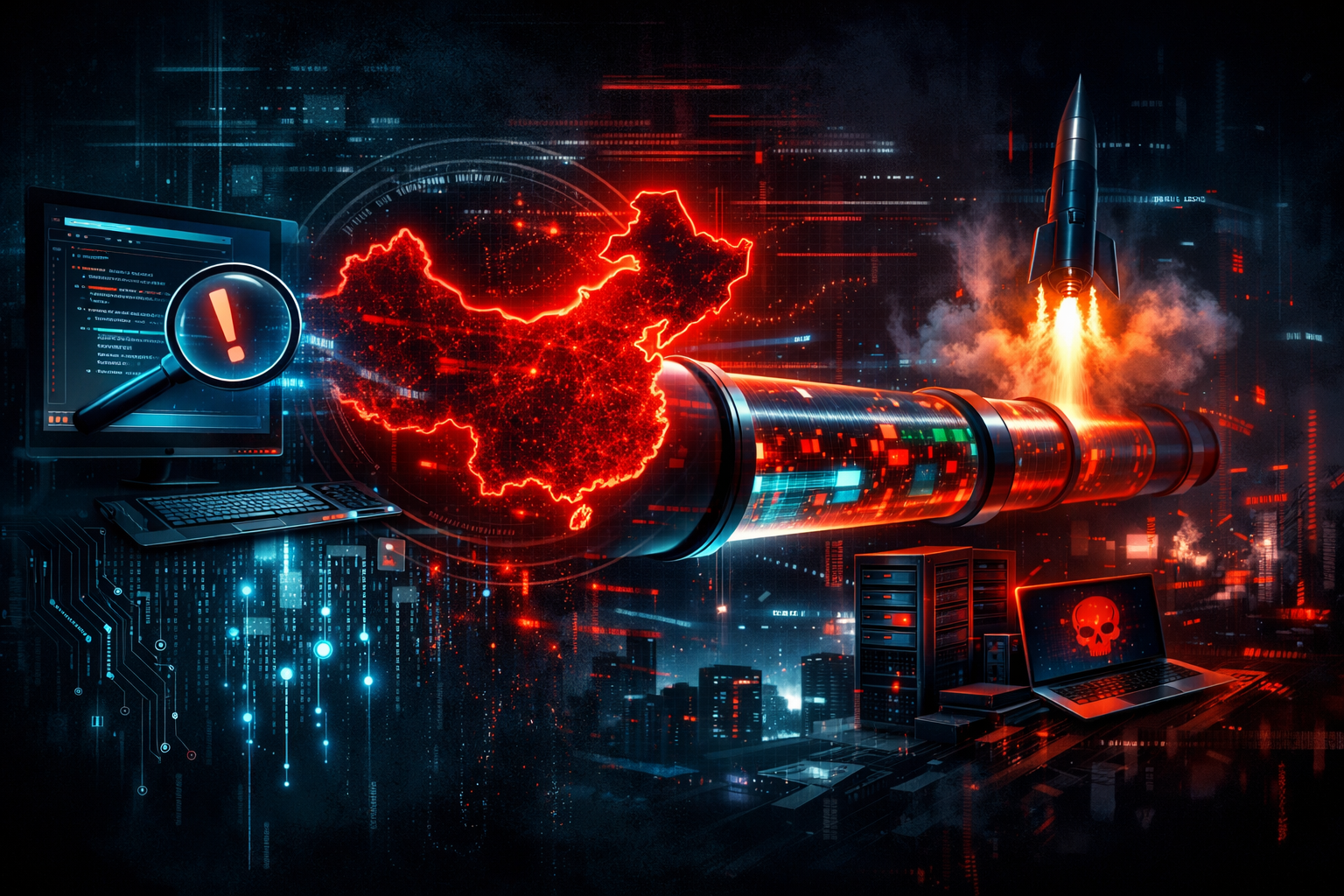
China’s cyber capability has long been associated with espionage, supply-chain compromise, and patient, long-term access operations. What stands out in recent reporting is the growing evidence that vulnerability discovery itself is being folded into state power. Recorded Future argues that China has built a system that can channel software flaws from researchers and companies toward government visibility and, potentially, operational use before the rest of the world has time to patch Recorded Future.
The key point is not that every Chinese researcher works for the state, or that every exploit discovered in China is automatically weaponized. Public evidence does not support such a simple picture. Instead, the record suggests a hybrid ecosystem: government ministries, state-linked databases, commercial security firms, independent researchers, and intelligence or military units operating under rules that can prioritize state access to vulnerability information Recorded Future.
That ecosystem matters because zero-days are among the most valuable tools in cyber operations. A zero-day gives an attacker a window of access before defenders know a flaw exists or have a patch in place. When that capability is tied to a national strategy, it can support intelligence collection, covert persistence, and pre-positioning inside strategic networks. U.S. officials have increasingly warned that Chinese cyber activity is not limited to data theft, but includes positioning inside critical infrastructure for possible future disruption or coercion CISA, FBI, and NSA.
China’s vulnerability governance framework is central to this discussion. Public reporting on Chinese regulations has described requirements for vulnerabilities to be reported to authorities and restrictions on how and when certain flaws can be publicly disclosed. Researchers have pointed in particular to the role of the China National Vulnerability Database and related regulatory mechanisms as evidence that the state has unusually strong visibility into newly discovered flaws Stanford DigiChina.
How the pipeline appears to work
The phrase “zero-day pipeline” is best understood as a process, not a single bureaucratic assembly line. In broad terms, the pipeline has four stages: discovery, reporting, prioritization, and deployment.
Discovery can happen in many places: internal security teams, bug hunters, commercial firms, exploit developers, academic researchers, or contractors. China has a large and technically sophisticated security research community, and some of that talent overlaps with state priorities Recorded Future.
Reporting is where China differs from more open vulnerability disclosure models. Regulations issued by China’s Ministry of Industry and Information Technology require network product vulnerabilities to be reported within a short period and impose limits on disclosure before remediation DigiChina translation of MIIT rules. In practice, that can give state authorities early access to vulnerability intelligence.
Prioritization likely determines whether a flaw is simply cataloged, shared for defensive remediation, retained for intelligence value, or passed to operational teams. This part is the least visible publicly, but it is where strategic advantage is created. A flaw in a niche local product has limited value; a flaw in Microsoft Exchange, Fortinet, Citrix, Ivanti, Barracuda, or a major identity platform can unlock access to governments, telecoms, and multinational firms at scale.
Deployment is the operational end of the chain. Chinese state-linked groups have repeatedly been associated with exploitation of internet-facing enterprise technology, especially edge devices and email infrastructure. These systems are attractive because they sit at trust boundaries and often provide a path into the rest of the network.
Technical details: the kinds of flaws that matter
The public reporting around Chinese-linked exploitation shows a recurring focus on remote access and perimeter technology. Common targets include email servers, VPN gateways, firewalls, reverse proxies, and cloud identity systems. These systems are exposed to the internet, hard to monitor deeply, and often run with elevated privileges.
Common vulnerability classes include remote code execution, authentication bypass, command injection, server-side request forgery, path traversal, and privilege escalation. Representative examples from major campaigns include Microsoft Exchange ProxyLogon and ProxyShell flaws such as CVE-2021-26855 and CVE-2021-34473, Citrix NetScaler CVE-2023-3519, Barracuda ESG CVE-2023-2868, Fortinet FortiOS SSL-VPN CVE-2023-27997, and Ivanti Connect Secure vulnerabilities CVE-2024-21887 and CVE-2024-21893 Microsoft, CISA, Barracuda.
The operational pattern is also familiar. Attackers gain initial access through an exposed appliance or server, establish persistence quickly, steal credentials or tokens, move laterally, and then blend into normal administration. Many Chinese intrusion sets are known for “living off the land” techniques: using legitimate tools, built-in commands, remote management features, and stolen identities rather than deploying obviously malicious binaries at every stage Mandiant.
That tradecraft makes zero-days more dangerous. A defender may patch the initial flaw but still miss the persistence implanted behind it. This is especially true on edge devices, where forensic visibility is often limited. In response to some Ivanti and Barracuda incidents, vendors and agencies warned that patching alone might not be enough and that full device replacement or deeper incident response review could be necessary CISA, Barracuda.
Why this matters strategically
The strategic advantage of a state-influenced zero-day pipeline is not just better hacking. It is the ability to industrialize access. If a government can see important vulnerabilities before vendors and customers can remediate them, it gains a recurring edge in intelligence collection. It can choose when to exploit quietly, when to hold a flaw in reserve, and when to scale exploitation across many targets.
That aligns with broader warnings about Chinese pre-positioning in critical infrastructure. In 2024, U.S. agencies described Volt Typhoon as a campaign focused on maintaining access in communications, energy, transportation, and water systems, using stealthy tradecraft and compromised small-office devices to obscure activity CISA, FBI, and NSA. The concern is not simply espionage in peacetime, but the possibility that latent access could be used during a crisis.
This is where vulnerability control becomes a national power issue. A centralized or state-favored process can turn software flaws into leverage over foreign networks. It also creates asymmetry: defenders must patch everything they can find, while an attacker needs only a few high-value weaknesses in widely deployed systems. Organizations relying on exposed remote access gear, weak segmentation, or incomplete logging are especially vulnerable.
Impact assessment
The most affected organizations are those with strategic value and complex internet-facing infrastructure. That includes governments, defense contractors, telecom providers, cloud and managed service providers, research institutions, and operators of critical infrastructure. Large enterprises are frequent targets, but smaller organizations can also be swept up when they use the same vulnerable appliances or act as supply-chain stepping stones Recorded Future.
The severity is high for three reasons. First, edge-device compromise often grants broad internal access. Second, these intrusions are usually designed for persistence and intelligence collection, so they can remain undetected for long periods. Third, when the same product is deployed across many sectors, one zero-day can become a mass-access event. The 2021 Exchange exploitation wave illustrated how quickly a single flaw chain can affect thousands of organizations globally Microsoft.
For individuals, the risk is usually indirect but real. Personal data, communications, and credentials can be exposed when employers, telecoms, universities, healthcare providers, or government agencies are compromised. Journalists, dissidents, researchers, and executives may face elevated risk if they are connected to organizations of intelligence interest.
How to protect yourself
Organizations should assume that perimeter devices are prime targets and defend accordingly.
Prioritize internet-facing systems. Maintain a current inventory of firewalls, remote access tools, email gateways, load balancers, and identity services. If you do not know what is exposed, you cannot defend it.
Patch edge devices fast. For products such as Ivanti, Citrix, Fortinet, Barracuda, and VPN gateways, shorten patch windows as much as possible. Subscribe to vendor advisories and CISA alerts. Where feasible, remove unnecessary public exposure and place management interfaces behind access controls.
Plan for compromise, not just prevention. When a zero-day is reported in a perimeter product, investigate for persistence, credential theft, and unusual outbound traffic even after patching. In some cases, a factory reset or hardware replacement may be safer than trusting a cleaned device.
Segment aggressively. A compromised appliance should not provide easy access to crown-jewel systems. Separate administrative networks, identity infrastructure, and sensitive data stores. Limit lateral movement paths.
Strengthen identity security. Use phishing-resistant multi-factor authentication, rotate credentials after edge-device incidents, and monitor for token abuse. Many post-exploitation chains rely more on stolen identities than on malware.
Improve visibility. Collect logs from network devices, authentication systems, cloud control planes, and endpoint tools into a central monitoring system. Edge appliances often have weak logging by default; tune them deliberately.
Secure remote access. Review whether exposed portals are necessary and protect sensitive traffic with strong encryption and modern authentication controls. For remote staff, using a trusted VPN service can reduce exposure on untrusted networks, though it does not replace patching or segmentation.
Follow threat intelligence and government guidance. Joint advisories from CISA, FBI, NSA, and allied agencies often include detection tips, hunting guidance, and mitigation steps tied to active Chinese campaigns CISA advisories.
The larger lesson is that software vulnerabilities are no longer just bugs to be fixed. In the China case, they increasingly appear to be inputs to state strategy. Whether every part of the pipeline is centrally directed remains open to debate, but the strategic effect is already visible: a system that can convert vulnerability research into durable geopolitical advantage.