Background and context
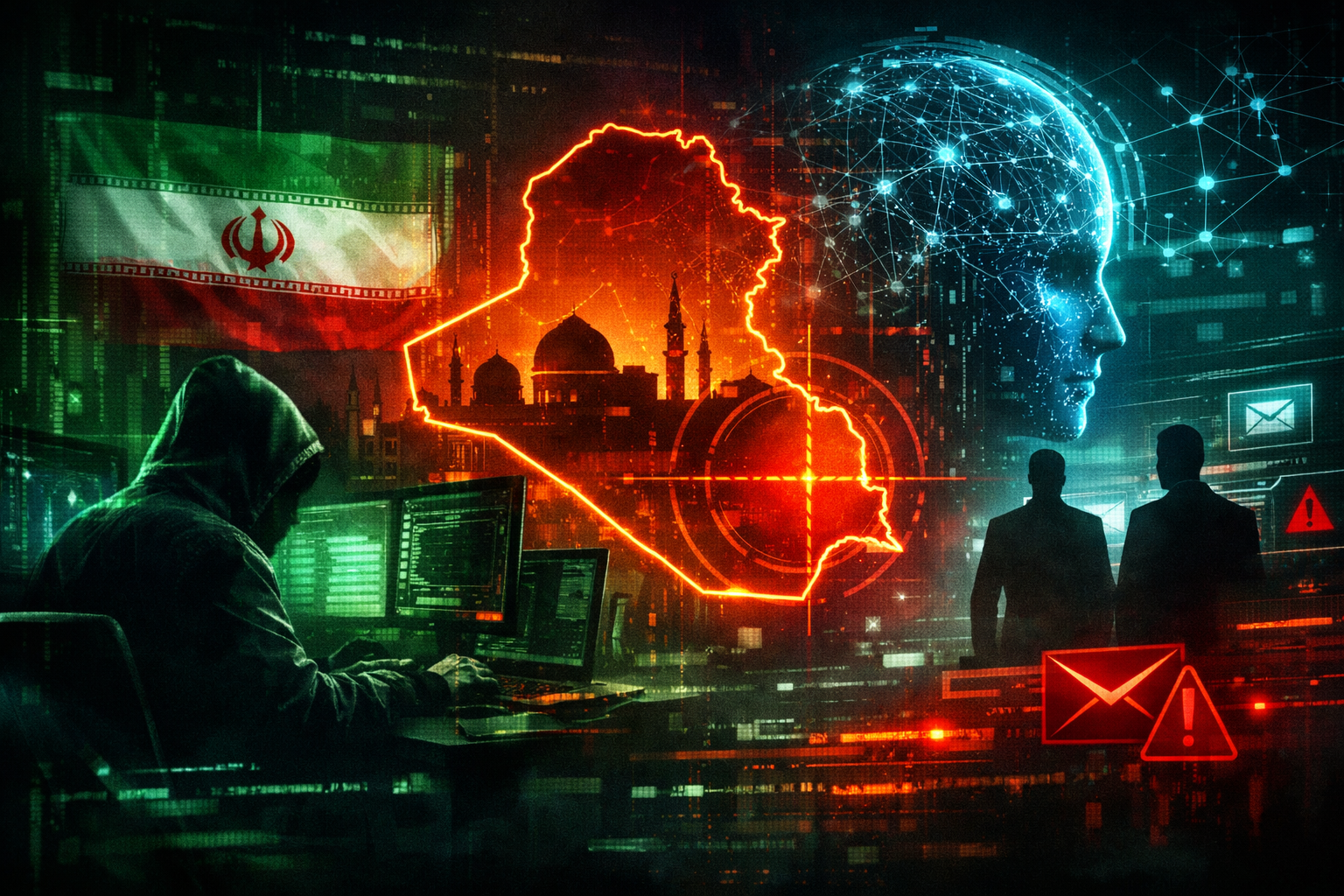
Zscaler ThreatLabz says an Iranian-linked threat actor targeted Iraqi government officials, including personnel associated with Iraq’s Ministry of Foreign Affairs, in what researchers described as an AI-powered campaign, with attribution assessed at medium to high confidence [1][2]. Even without public evidence of an AI-driven malware payload, the case is significant because it points to a familiar espionage model getting more efficient: state-aligned operators using AI to sharpen phishing, translation, impersonation, and lure development rather than reinventing the intrusion chain itself [1][3].
The target selection matters as much as the tooling. Foreign ministries sit at the center of diplomatic communications, travel planning, policy coordination, sanctions discussions, and contact networks. Access to even a small number of official mailboxes can reveal negotiation positions, internal reporting, and relationship maps across governments and international organizations. For Iran, Iraq remains a strategically important intelligence target due to geography, politics, militia ties, energy issues, and the country’s role in regional diplomacy [4][5].
This operation also fits a long-running pattern. Iranian state-aligned groups such as APT34/OilRig, APT35/Charming Kitten, and MuddyWater have repeatedly been linked by governments and private-sector researchers to credential theft, spearphishing, cloud account compromise, and long-term espionage against governments, NGOs, telecoms, and critical sectors across the Middle East and beyond [4][6][7]. What appears newer here is the explicit AI angle: researchers increasingly describe generative AI as an operational amplifier that reduces the friction involved in writing convincing emails, localizing lures, and tailoring messages to specific officials [3][8].
Technical details
Based on the reporting available, the most likely attack path was spearphishing leading to credential harvesting or account compromise rather than exploitation of a named software vulnerability [1][2]. That distinction is important. Many “AI-powered” campaigns do not use AI inside the malware. Instead, AI is used by the operator to create more believable text, improve Arabic or English phrasing, summarize open-source intelligence on targets, and iterate quickly on impersonation content [3][8].
For a campaign aimed at foreign ministry personnel, plausible lure themes include meeting requests, diplomatic correspondence, travel documents, policy briefs, security updates, and invitations tied to regional events. Threat actors often pair those lures with lookalike domains, cloned Microsoft 365 login pages, or cloud-hosted phishing kits. Once a target enters credentials, the operator can attempt direct account access, trigger MFA fatigue, steal session cookies, or seek OAuth consent that grants persistent access to mailbox data [6][9].
Zscaler’s medium-to-high-confidence attribution likely rests on a combination of victimology, infrastructure patterns, language use, operational timing, and overlap with known Iranian tradecraft rather than a single smoking gun [1]. That is common in state-linked intrusion analysis. Public attribution in these cases is usually probabilistic, built from clusters of evidence such as domain registration behavior, phishing themes, command-and-control characteristics, and similarities to earlier campaigns tracked by vendors or national cyber agencies [4][6].
Iranian espionage groups have often favored low-cost, high-yield methods over noisy zero-day exploitation. Joint advisories from CISA and partner agencies have repeatedly highlighted tactics such as password spraying, phishing, abuse of legitimate remote administration tools, and cloud-focused persistence [6][7]. In that sense, AI does not replace established tradecraft; it improves the social engineering front end. A cleaner email, a more natural translation, or a lure tailored to a real diplomatic calendar can raise click-through rates without changing the rest of the intrusion chain.
Defenders should also pay attention to post-compromise signs that often follow credential theft. These include anomalous sign-ins from unfamiliar geographies, impossible-travel events, newly created mailbox forwarding rules, OAuth application grants that users do not recognize, unusual downloads of archived mail, and access attempts outside normal working hours [6][9]. In diplomatic environments, where officials travel frequently and use mobile devices, those signals can be easy to miss unless identity and mailbox telemetry are closely monitored.
Impact assessment
The direct victims are Iraqi government officials, especially those tied to the Ministry of Foreign Affairs [1][2]. The indirect impact could extend much further. A compromised diplomat or ministry staffer may expose not only their own correspondence but also communications with foreign embassies, international institutions, contractors, journalists, and partner ministries. That can create a cascading intelligence loss well beyond one account.
From a severity standpoint, this is best understood as a high-value espionage threat rather than a mass-disruption event. There is no public indication from the reporting that the campaign caused destructive effects or widespread service outages [1][2]. But espionage intrusions into foreign ministry systems can have strategic consequences out of proportion to the number of infected or compromised users. Access to policy drafts, travel schedules, internal debates, and contact lists can support influence operations, counter-diplomacy, coercive pressure, or future cyber targeting.
The campaign also illustrates a broader risk for public-sector organizations across the region. Ministries and diplomatic offices are attractive targets because they often operate across multiple languages, communicate externally at high volume, and handle urgent requests from a wide set of partners. Those conditions favor social engineering. AI-assisted content generation makes that problem worse by allowing operators to produce polished, context-aware lures at scale [3][8].
For ordinary users, the immediate risk is lower than for government personnel, but the trend still matters. Techniques refined against diplomats often trickle down into campaigns aimed at journalists, researchers, NGOs, and diaspora communities. Iranian groups in particular have been linked in past reporting to targeting dissidents, academics, and policy experts through impersonation-heavy phishing and credential theft [4][10].
Why the AI angle matters — and where the hype should stop
The phrase “AI-powered” can easily overstate what is happening. In this case, the more grounded interpretation is that AI likely improved operator productivity and message quality rather than introducing autonomous cyber weapons. That still matters. Phishing has long been constrained by language errors, awkward formatting, and limited personalization. Generative AI helps remove those weaknesses. It can draft convincing diplomatic language, mimic bureaucratic tone, translate between Arabic and English with fewer obvious mistakes, and create variants of a lure in minutes [3][8].
At the same time, AI does not erase the need for the basics. These campaigns still depend on a victim trusting a message, entering credentials, approving an MFA prompt, or granting access to a malicious application. That means the strongest defenses remain identity protection, phishing-resistant authentication, mailbox monitoring, and disciplined user verification practices. For sensitive communications, organizations may also consider stronger encryption and segmented channels for high-risk exchanges.
How to protect yourself
For government agencies, NGOs, and organizations that interact with diplomatic staff, the defensive lessons are straightforward:
Deploy phishing-resistant MFA. Prefer FIDO2 security keys or platform-based passkeys over SMS or push-only MFA, which are more vulnerable to interception, fatigue attacks, or social engineering [6][9].
Harden cloud identity controls. Use conditional access policies, block legacy authentication, restrict risky sign-ins, and review OAuth application consent settings. Many modern espionage campaigns aim at cloud mailboxes rather than on-premise systems [6][9].
Monitor mailbox abuse. Alert on new forwarding rules, suspicious inbox rules, mass message downloads, and access from unusual IP ranges. These are common signs of account takeover.
Verify requests out of band. If an email asks for credentials, urgent document review, or approval of an app login, confirm by phone or a separate trusted channel before acting.
Train for high-context spearphishing. Awareness programs should include realistic examples of diplomatic lures, multilingual phishing, and impersonation of partner ministries or international bodies. AI-generated messages may look more polished than older phishing emails.
Use email authentication controls. Enforce SPF, DKIM, and DMARC to reduce spoofing and improve detection of impersonation attempts.
Protect sensitive browsing and travel communications. Officials working abroad or on untrusted networks should use secure, managed devices and consider a trusted VPN service as part of a broader privacy protection and access-control strategy.
Keep incident response focused on identity. If compromise is suspected, reset sessions, revoke tokens, review OAuth grants, rotate credentials, and inspect mailbox activity before assuming the issue is contained.
Bottom line
The reported campaign against Iraqi government officials is less a story about futuristic AI malware than one about espionage tradecraft becoming cheaper, faster, and more convincing. Zscaler’s assessment adds to a growing body of evidence that state-aligned actors are folding generative AI into social engineering workflows [1]. For ministries, diplomats, and anyone in their communication orbit, the practical consequence is clear: phishing defenses now have to contend with more fluent, more targeted, and more scalable deception.
Sources: [1] Zscaler ThreatLabz; [2] Infosecurity Magazine; [3] Microsoft Threat Intelligence; [4] Mandiant/Google Cloud; [5] Recorded Future; [6] CISA; [7] FBI/CISA/NSA advisories; [8] Google Threat Intelligence Group; [9] Microsoft security guidance; [10] Citizen Lab.