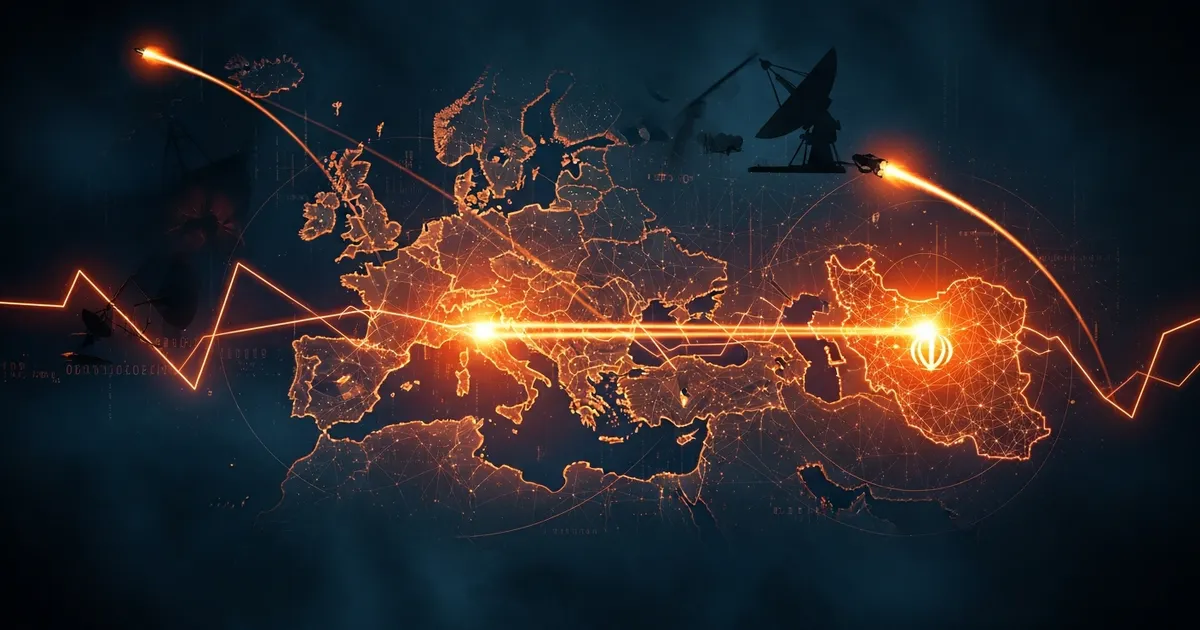
High-Stakes Diplomacy Creates a Cyber Battleground
In late 2019, a report from the Financial Times sent shockwaves through diplomatic circles. It alleged that then-U.S. President Donald Trump had threatened key European allies to pressure their stance on Iran. The specific issue cited in the report concerned the Strait of Hormuz. The report further claimed that U.S. military aid to Ukraine was dangled as a bargaining chip in these tense negotiations. While the incident was fundamentally one of geopolitical hardball, it ripped open a new front in the cyber domain, creating fertile ground for espionage, disinformation, and strategic destabilization.
Background: A Fractured Alliance and a Nuclear Deal on Life Support
To understand the cyber implications, we must first grasp the geopolitical context. By November 2019, the transatlantic alliance was already under considerable strain. The U.S. had unilaterally withdrawn from the Joint Comprehensive Plan of Action (JCPOA), commonly known as the Iran nuclear deal, in May 2018, a move its European partners vehemently opposed. Washington then initiated a "maximum pressure" campaign of sanctions to cripple Iran's economy, while the E3 nations scrambled to preserve the agreement.
According to the Financial Times report, citing several European officials, the alleged threats were made during the United Nations General Assembly in September 2019. This high-pressure tactic was designed to force Europe's hand, shatter the remaining consensus around the JCPOA, and align the continent with Washington's aggressive stance. The alleged linkage to Ukraine aid was particularly explosive, as it echoed the core accusations of the impeachment inquiry against President Trump that was unfolding at the same time.
Technical Details: The Cyber Shadow War
A diplomatic threat of this magnitude does not have a Common Vulnerabilities and Exposures (CVE) number. There are no malware signatures or Indicators of Compromise (IOCs) directly associated with the conversation itself. However, the fallout from such a high-stakes confrontation immediately creates high-value targets and incentives for state-sponsored cyber operations.
1. State-Sponsored Cyber Espionage: When allies are at odds, the need for intelligence skyrockets. Advanced Persistent Threat (APT) groups, particularly those linked to Iran, Russia, and China, would have viewed this rift as a golden opportunity. Their primary objective would be to infiltrate the digital communications of the involved foreign ministries, diplomatic missions, and key policymakers. Attack vectors would likely include:
- Spear-Phishing Campaigns: Highly targeted emails sent to diplomats, aides, and policy advisors, crafted to look like legitimate internal communications about the Iran deal or U.S. trade policy. The goal would be credential theft or malware deployment to gain a foothold in sensitive government networks.
- Supply Chain Attacks: Compromising third-party vendors that provide software or services to government agencies, such as secure communication platforms or IT management tools.
- Exploitation of Zero-Days: Using previously unknown software vulnerabilities to bypass defenses and access encrypted correspondence or internal strategy documents.
The intelligence gathered—such as European red lines, internal disagreements, or fallback positions—would be invaluable not only to Tehran but also to Moscow and Beijing, who could use it to further drive a wedge between the U.S. and its allies.
2. Disinformation and Influence Operations: Geopolitical disputes are prime fodder for disinformation. Adversarial nations would have mobilized their state-backed media outlets and social media troll farms to amplify news of the rift. The narratives would be tailored to specific audiences: painting the U.S. as an unreliable and bullying partner to European citizens, while portraying European leaders as weak and subservient to American interests for domestic audiences in Russia or Iran. The goal is not just to report the news, but to weaponize it to erode public trust in democratic institutions and alliances.
Impact Assessment: A Trust Deficit with Digital Consequences
The impact of the alleged threats extends far beyond the involved diplomatic parties. The primary casualty was trust, a foundational element of both international alliances and collective cybersecurity.
- Affected Parties: The most directly affected were the governments of the U.S., France, Germany, and the UK. Indirectly, Ukraine's national security was jeopardized by its aid being used as leverage, and the European automotive industry faced immense economic uncertainty.
- Severity: The incident severely damaged the cohesion of the transatlantic alliance. When allies cannot trust each other, cooperation on critical security matters—including cyber defense and threat intelligence sharing—degrades. An adversary no longer needs to break through a united front; they can simply exploit the pre-existing cracks.
- Cyber Resilience Implications: For Europe, this event underscored the need for greater strategic and digital autonomy. The reliance on a partner willing to use such coercive tactics could accelerate European efforts to develop independent cyber capabilities and secure communication infrastructures, reducing dependence on U.S. technology and intelligence frameworks.
How to Protect Yourself: A Playbook for National Security Organizations
While individuals are not the direct targets in this scenario, the principles of defense are scalable and offer lessons for any organization handling sensitive information in a contentious environment. For government agencies and diplomatic corps, the following steps are paramount.
- Assume a Compromised Environment: Operate under a Zero Trust security model. This means verifying every user and device attempting to access resources on a network, regardless of their location. Trust is never implicit, even for internal communications.
- Fortify Communication Channels: All sensitive diplomatic and strategic discussions must be protected with strong, end-to-end encryption. This includes everything from email and messaging apps to video conferencing. Scrutinize the supply chain of all communication hardware and software for potential backdoors or vulnerabilities.
- Train for Psychological Resilience: Personnel must be trained to identify and resist sophisticated social engineering and disinformation campaigns. This involves fostering a culture of critical thinking and providing clear channels for reporting suspected influence operations or phishing attempts.
- Compartmentalize Information: Limit access to sensitive negotiation strategies and intelligence to only those with a strict need-to-know. This minimizes the potential damage if a specific individual or department is compromised.
- Enhance Counter-Intelligence: Bolster digital counter-intelligence capabilities to actively hunt for threats within networks. Proactive threat hunting can detect APT activity before a major data breach occurs, moving from a passive defense to an active one.
Ultimately, the alleged threat over the Strait of Hormuz and Ukraine aid serves as a stark reminder that 21st-century statecraft is a hybrid affair. A diplomatic hardline in a closed-door meeting can create cyber vulnerabilities across the globe, forcing nations to defend not only their economic and security interests but also the integrity of the information that underpins them.