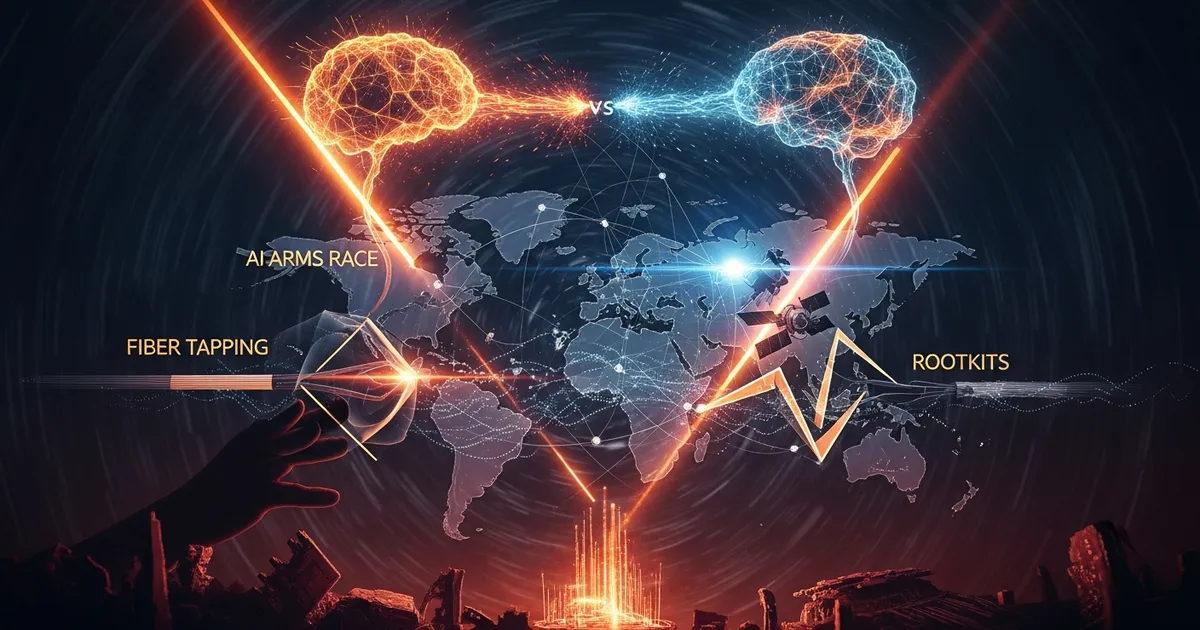
Introduction: The Unseen Dangers of a Connected World
This week, the cybersecurity community is grappling with a series of threats that operate in the shadows, from physical infrastructure manipulation to malware that burrows deeper than the operating system itself. We are tracking revelations of aggressive state-sponsored meddling in communications infrastructure, the discovery of a highly persistent Windows rootkit, and a critical vulnerability that may have been hiding in PDF documents for months. These incidents highlight a common theme: the most significant dangers are often the ones you cannot easily see.
The Wires are Listening: Nation-States Target Critical Infrastructure
Reports are solidifying around long-term campaigns by nation-state actors, most notably the group tracked as Volt Typhoon (linked to the People's Republic of China), targeting critical infrastructure in the United States and allied nations. Their objective appears to be less about immediate data theft and more about strategic pre-positioning. By gaining persistent access to telecommunications, energy, and water systems, these actors could disrupt or disable essential services during a future geopolitical conflict.
Technical Details: Living Off the Land
What makes this activity so difficult to detect is the adversary's extensive use of "living off the land" (LotL) techniques. Instead of deploying custom, noisy malware, they leverage legitimate tools and credentials already present on the network. Initial access is often gained through vulnerabilities in public-facing devices like firewalls and VPN concentrators. Once inside, they use standard administrative tools such as PowerShell, Windows Management Instrumentation (WMI), and remote desktop clients to move laterally and escalate privileges. This behavior blends in with normal network administration, making it a nightmare for security operations centers to distinguish malicious activity from benign tasks. The focus is on establishing a quiet, long-term foothold, waiting for a command to act.
Impact Assessment
The primary targets are organizations that form the backbone of modern society. A successful disruptive attack could have catastrophic consequences, leading to widespread power outages, communication blackouts, and failures in public services. According to a joint advisory from CISA, the NSA, and the FBI, this threat is not theoretical; it represents a clear and present danger to national security.
Below the Operating System: The Resurgence of the UEFI Rootkit
While infrastructure threats loom, a different kind of deeply embedded threat has re-emerged in the form of a sophisticated Windows rootkit. Security researchers have detailed a UEFI bootkit, similar in function to threats like BlackLotus, capable of subverting one of the most fundamental security features of modern computers: Secure Boot. This type of malware operates at a level below the operating system, making it exceptionally persistent and stealthy.
Technical Details: Corrupting Trust at the Firmware Level
UEFI (Unified Extensible Firmware Interface) is the software that bridges a computer's hardware and its operating system. A UEFI rootkit compromises this firmware. By exploiting vulnerabilities in the boot process, such as CVE-2022-21894, an attacker can insert malicious code that executes before Windows even begins to load. This allows the malware to disable operating system security features like BitLocker disk encryption and Hypervisor-Protected Code Integrity (HVCI) from the outset. Because the malicious code resides in the motherboard's firmware or the EFI System Partition, it survives operating system re-installations and even hard drive replacements. Detection requires specialized tools that can inspect firmware integrity, a capability beyond most standard antivirus solutions.
Impact Assessment
These rootkits are the tools of apex predators, typically deployed by well-funded APT groups against high-value targets like government agencies, defense contractors, journalists, and dissidents. For an infected organization, the compromise is total. The attacker gains near-complete control and long-term persistence, enabling deep espionage and data exfiltration that can go undetected for years.
The Ghost in the Document: A Zero-Day Haunts PDFs
Adding to the week's concerns is the discovery of a critical zero-day vulnerability reportedly affecting multiple widely-used PDF reader applications. This flaw, which appears to have been exploited in the wild for months before its discovery, allows for arbitrary code execution when a user simply opens a malicious document. The PDF format, with its complex structure and support for scripting and embedded media, remains a fertile ground for exploitation.
Technical Details: Exploiting Memory Corruption
This type of vulnerability often stems from memory corruption bugs, such as a heap overflow or use-after-free, in the software's rendering engine. An attacker crafts a special PDF file that, when parsed by the vulnerable application, triggers the bug and allows them to write to and execute code from memory locations they should not have access to. The initial payload is often a small piece of shellcode that downloads a more full-featured malware implant from a command-and-control server. The attack is effective because it exploits the implicit trust users have in common document formats.
Impact Assessment
Every organization and individual that handles PDF documents is a potential victim. This vulnerability serves as an ideal initial access vector for ransomware gangs, financial criminals, and espionage groups. A single employee opening a weaponized invoice or resume can lead to a full network compromise.
The Double-Edged Sword: AI Joins the Vulnerability Hunt
A parallel development this week is the increasing prominence of Artificial Intelligence in vulnerability research. Initiatives like DARPA's AI Cyber Challenge (AICC) are pushing the boundaries of using AI to automatically find and fix software flaws at a scale and speed impossible for human researchers. While this promises a future with more secure software, it also presents a new challenge: what happens when adversaries use the same technology?
AI models can be trained on vast codebases to identify complex vulnerability patterns, generate highly effective fuzzing inputs, and even create proof-of-concept exploits. This is a powerful tool for defenders, but it also lowers the barrier to entry for attackers. The same AI that finds a flaw for a developer can find it for a malicious actor, creating a new kind of arms race in cyberspace.
How to Protect Yourself
While these threats are sophisticated, there are concrete steps organizations and individuals can take to mitigate their risk:
- Patch Diligently and Promptly: The PDF zero-day and the vulnerabilities exploited by rootkits and infrastructure attackers all rely on unpatched software. Apply security updates for operating systems, firmware, and applications as soon as they become available.
- Harden Network Edge Devices: Change default credentials, disable unnecessary services, and implement strict access controls on firewalls, routers, and VPNs. These are the front doors to your network.
- Implement Network Segmentation: Prevent attackers from moving freely across your network. By segmenting critical systems from general user networks, you can contain a breach and limit its impact.
- Enable Firmware and Boot Security: Ensure that Secure Boot is enabled in the UEFI settings of all endpoints. Use tools that can monitor firmware integrity where possible.
- Enhance User Awareness: Train users to be suspicious of unsolicited attachments, even common file types like PDFs. Phishing remains the number one entry point for many attacks.
- Secure Your Connection: For individuals and remote workers, using a VPN service can encrypt internet traffic, protecting data from eavesdropping on untrusted networks.
- Assume Breach: Adopt a mindset of continuous monitoring and threat hunting. Implement Endpoint Detection and Response (EDR) solutions to look for anomalous behavior indicative of LotL techniques.