Background and context
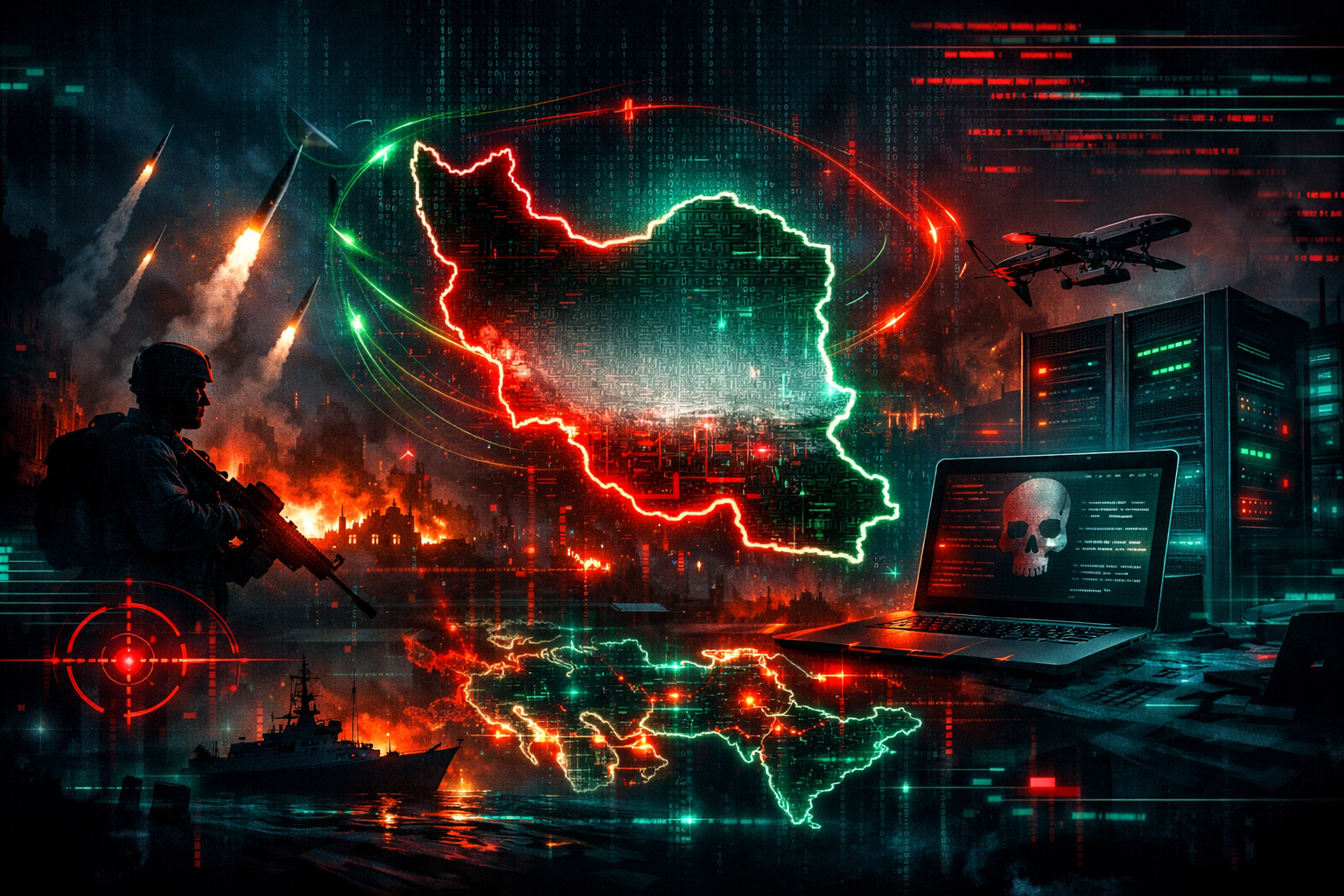
Recorded Future’s Insikt Group has framed the current confrontation around Iran as more than a conventional military crisis: it is a multi-domain conflict where airstrikes, proxy warfare, cyber operations, maritime pressure, and information campaigns can reinforce each other [1]. That framing matches a long public record of Iran-related escalation. For more than a decade, tensions involving Iran, Israel, and the United States have repeatedly crossed from covert action into cyber disruption, espionage, and regional military signaling [2][3].
The modern backdrop starts with the Stuxnet operation against Iran’s nuclear program, widely attributed by multiple media investigations to U.S. and Israeli efforts, which showed that cyber sabotage could produce strategic physical effects [4]. Iran then expanded its own cyber capabilities, developing a track record in disruptive and retaliatory operations. Publicly attributed examples include distributed denial-of-service attacks on U.S. banks, destructive malware campaigns such as Shamoon against Gulf targets, and sustained espionage against government, telecom, defense, and energy organizations [5][6][7].
Since the U.S. withdrawal from the Joint Comprehensive Plan of Action in 2018 and especially after the 2020 killing of Qassem Soleimani, analysts have repeatedly warned that Iranian retaliation may come through a mix of cyber and physical channels rather than through direct state-on-state war alone [3][8]. The Israel-Hamas war and broader regional instability have added another layer, increasing the chance that strikes on Iranian assets or leadership could trigger cyber operations against Israeli, U.S., Gulf, and Western-linked targets [1][9].
That is why the phrase “Iran war” should be read carefully. It does not only describe bombs and missiles. It also describes a contest in which cyber activity can be used for signaling, coercion, retaliation, and confusion, often below the threshold of open war but still capable of causing serious operational harm [1][7].
Technical details: how escalation could play out online
Iran-linked groups have historically shown strength in disruptive and opportunistic operations rather than only in highly advanced sabotage. Joint advisories from CISA, the FBI, NSA, and partner agencies have repeatedly described Iranian actors exploiting known vulnerabilities in internet-facing devices, using password spraying, phishing, credential theft, and remote administration tools to gain footholds [5][10].
In a crisis tied to U.S.-Israeli strikes, defenders should expect four broad mission sets.
First is espionage and pre-positioning. Groups commonly tracked as MuddyWater, OilRig/APT34, APT33, Fox Kitten, and Charming Kitten have been linked by public reporting to credential theft, mailbox access, cloud compromise, and long-term persistence [6][7][11]. This matters because the most dangerous attacks often begin months before visible disruption. An actor that already has access to email, VPN accounts, or administrator consoles can move quickly when political leaders decide to escalate.
Second is disruption. Iranian operations have included DDoS attacks, website defacement, and data leaks aimed at public visibility and psychological effect [5][7]. These tactics are relatively cheap, fast to deploy, and useful for creating headlines. During a regional crisis, they may be used against municipalities, transportation firms, media outlets, logistics providers, or public-facing government services.
Third is destructive activity. The best-known precedent is Shamoon, which wiped systems in Gulf organizations and demonstrated willingness to destroy data rather than merely steal it [12]. More recent threat reporting has also warned that Iran-linked actors can blend ransomware-style tradecraft with destructive intent, making an incident look financially motivated at first glance while actually serving political aims [7]. For incident responders, that means any sudden ransomware or wiper event affecting energy, shipping, healthcare, or government networks during a geopolitical crisis deserves closer scrutiny.
Fourth is influence and intimidation. Iranian operators and aligned personas have used hacked-and-leaked operations, impersonation, and social engineering to shape narratives and unsettle targets [11][13]. Journalists, researchers, diplomats, activists, and executives may be singled out with phishing lures tied to breaking news, military mobilization, sanctions, or emergency alerts.
Technically, the most exposed points are often edge systems and identity layers. Public advisories have linked Iranian exploitation activity to flaws in Citrix, F5, Palo Alto, and Ivanti products, among others, because these devices sit at the boundary between the internet and internal systems [5][10][14][15]. Vulnerabilities such as CVE-2023-4966 (“Citrix Bleed”), CVE-2024-21887 in Ivanti Connect Secure, and CVE-2024-3400 in Palo Alto PAN-OS have all been the kind of issues that state-linked actors race to exploit after disclosure [14][15][16]. If a conflict-driven campaign unfolds, organizations should assume that unpatched remote access systems, exposed web apps, and weak identity controls will be the first targets.
Another consistent pattern is use of legitimate tools after compromise. Rather than deploying obviously custom malware immediately, intruders may rely on PowerShell, remote monitoring tools, scheduled tasks, cloud administration features, and stolen OAuth or VPN sessions. That makes detection harder because activity can blend into normal administrative behavior [6][10]. Organizations using VPN service gateways, single sign-on portals, and cloud email should treat unusual logins, impossible travel, MFA fatigue attempts, and suspicious mailbox rules as high-priority signals.
Impact assessment
The most exposed sectors are government, defense, energy, oil and gas, maritime shipping, aviation, telecommunications, water utilities, transportation, and healthcare [1][5][9]. Israel and Iran are obvious focal points, but the blast radius is broader. U.S. agencies, Gulf states, European firms with regional operations, and multinational companies tied to logistics or critical infrastructure could all be affected indirectly.
For businesses, the likely near-term impact is operational disruption rather than cyber catastrophe. DDoS attacks can interrupt customer portals. Defacements can damage trust. Phishing and credential theft can expose sensitive communications. Wipers or destructive ransomware can halt business operations and create long recovery timelines. For critical infrastructure operators, even limited IT disruption can spill into safety, scheduling, and supply-chain issues if corporate networks support plant operations, dispatch systems, or emergency communications [5][10].
The maritime and energy sectors face special risk. Iran has a long history of using pressure around shipping lanes and regional energy infrastructure as leverage [9]. Cyber incidents affecting ports, freight systems, tanker logistics, or fuel distribution may not be as dramatic as missile strikes, but they can still raise insurance costs, delay cargo, and amplify market anxiety. That is one reason threat intelligence firms often pair cyber warnings with geopolitical and physical risk analysis [1].
Individuals are also in scope. Government officials, military personnel, journalists, policy researchers, dissidents, and employees in targeted sectors may face phishing, account takeover, surveillance, or doxxing attempts [11][13]. During periods of crisis, attackers often exploit urgency: fake security bulletins, false evacuation notices, sanctions updates, and media requests can all become lures.
Severity depends on timing and objectives. A symbolic cyber response may be noisy but manageable. A coordinated campaign combining cyber intrusions, destructive malware, disinformation, and proxy attacks would be more serious because it stretches defenders across technical, physical, and communications fronts at once [1][7].
How to protect yourself
Organizations should start with the basics that matter most during state-linked campaigns.
Patch internet-facing systems immediately. Prioritize VPN gateways, firewalls, remote access appliances, Citrix, Ivanti, Palo Alto, F5, and externally exposed web applications [10][14][15][16]. If emergency patching is not possible, restrict exposure with access control lists, geofencing where appropriate, and temporary shutdown of nonessential services.
Harden identity. Enforce phishing-resistant MFA for administrators and remote access. Review dormant accounts, service accounts, and mailbox forwarding rules. Monitor for impossible-travel logins, MFA push abuse, and session hijacking indicators. If you provide remote access for staff or contractors, secure it with strong authentication and review logs from your hide.me VPN or other remote access infrastructure for anomalous access patterns.
Assume email and cloud are prime targets. Hunt for suspicious OAuth grants, unusual inbox rules, mass downloads, and login activity from residential proxies or unfamiliar hosting providers [6][11].
Prepare for destructive incidents. Test offline and immutable backups. Verify that recovery plans work without domain authentication. Segment backup infrastructure from production. During geopolitical crises, restoring quickly matters as much as preventing compromise.
Improve detection on edge and admin activity. Collect logs from VPNs, identity providers, web servers, EDR, DNS, and cloud control planes. Alert on new admin creation, remote tool deployment, web shell indicators, and PowerShell spawned by unusual parent processes [5][10].
Brief staff on crisis-themed phishing. Warn employees that messages about military escalation, travel restrictions, sanctions, aid requests, or emergency policy changes may be malicious. High-risk users such as executives, journalists, and regional staff should receive tailored guidance.
Coordinate cyber and physical security. If your organization operates in shipping, energy, transport, or public services, make sure cyber, legal, communications, and physical security teams are working from the same escalation plan. Multi-domain incidents rarely stay in one lane.
Follow official alerts. CISA, FBI, NSA, and sector-specific ISACs often publish timely indicators and mitigation guidance during periods of heightened tension [5][10].
Why this conflict deserves close attention
The central lesson from years of Iran-related threat activity is that retaliation does not need to look like a single spectacular cyberattack to be effective. A campaign of credential theft, selective leaks, DDoS attacks, wipers, and pressure on shipping or energy networks can still impose real costs and create strategic uncertainty. That is the scenario analysts are watching now: not only whether strikes occur, but whether cyber and physical responses are synchronized in ways that widen the conflict far beyond the battlefield [1][9].
For defenders, the practical takeaway is straightforward. If your organization touches government, critical infrastructure, regional logistics, media, or high-profile policy work, this is a moment to tighten edge security, verify recovery readiness, and watch identity systems closely. History suggests that when tensions with Iran spike, cyber activity often follows [3][5][7].