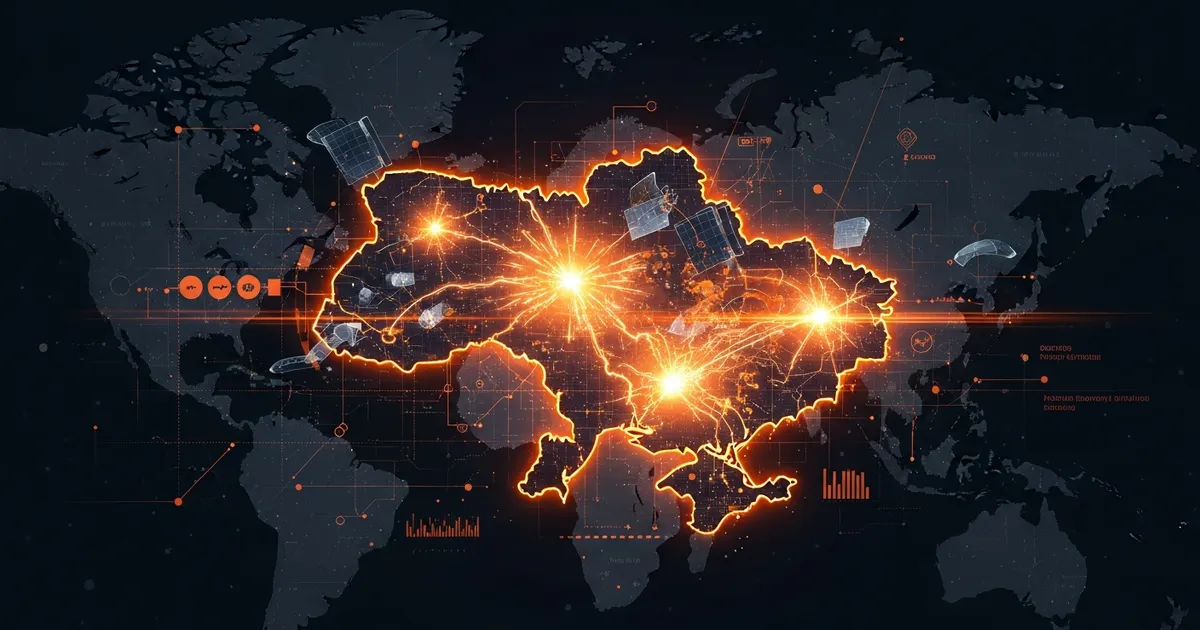
Introduction: The War Beyond the Headlines
Recent headlines depict Ukrainian drones striking deep inside Russia, targeting oil refineries and energy depots in a tangible expansion of the conflict. While these physical attacks capture global attention, they represent only one front in a long-running war against energy infrastructure. A parallel, often invisible conflict has been waged for years in cyberspace, with Russian state-sponsored actors repeatedly targeting Ukraine's power grid and other critical services in a calculated campaign of disruption.
This digital offensive, which predates the 2022 full-scale invasion by nearly a decade, provides a chilling case study in modern hybrid warfare. By dissecting these pioneering cyberattacks, we can understand not only the evolution of digital warfare but also the profound risks facing critical infrastructure worldwide.
A History of Digital Disruption
The cyber dimension of the Russo-Ukrainian conflict began long before tanks crossed the border. It has been a persistent effort to destabilize, demoralize, and degrade Ukraine's ability to function. The primary actor in many of these incidents is a group widely attributed to Russia's GRU military intelligence agency, known to cybersecurity researchers as Sandworm or APT28.
Their campaign against Ukraine's energy sector created a series of alarming firsts, demonstrating a clear intent to cause physical-world consequences through digital means.
Technical Deep Dive: The Evolution of Grid Attack Malware
The attacks on Ukraine's power grid were not opportunistic; they were meticulously planned operations that evolved in sophistication over time, showcasing a deep understanding of Industrial Control Systems (ICS) and Operational Technology (OT).
2015: The BlackEnergy Attack
On December 23, 2015, the world witnessed the first confirmed power outage caused by a cyberattack. Hackers successfully cut power to approximately 225,000 customers in western Ukraine. The attack was a multi-stage process:
- Initial Access: The attackers used spear-phishing emails containing malicious Microsoft Office attachments sent to employees at three different power distribution companies.
- Reconnaissance and Lateral Movement: Once inside the IT networks, the attackers used the BlackEnergy3 malware to explore the network, steal credentials, and pivot into the highly sensitive ICS network.
- The Strike: After gaining control of the Supervisory Control and Data Acquisition (SCADA) systems, the operators manually opened circuit breakers, causing the blackout. To hinder recovery, they deployed a wiper component called KillDisk to erase data on critical systems and executed a denial-of-service attack on the utility's call centers. (Source: Mandiant)
2016: The Arrival of Industroyer (CrashOverride)
A year later, Sandworm struck again, this time targeting a transmission substation in Kyiv. This attack was technically a significant escalation. Instead of manually interacting with operator interfaces, the attackers deployed Industroyer, a modular malware framework purpose-built to attack power grids.
What made Industroyer so formidable was its ability to "speak" the native industrial communication protocols used in energy infrastructure, such as IEC 61850 and IEC 60870-5-104. This allowed the malware to directly send commands to circuit breakers and other control equipment automatically. It was a weaponized, scalable tool for causing blackouts, representing a dangerous evolution from the more manual approach used in 2015. (Source: ESET)
2022: The Thwarted Industroyer2 Attack
Just weeks into the full-scale invasion, Sandworm attempted to reprise its success. In April 2022, Ukrainian authorities, with assistance from Microsoft and ESET, detected and neutralized an attack aimed at a major Ukrainian energy provider. This operation involved a new variant, Industroyer2, deployed alongside a destructive wiper named CaddyWiper. The plan was clear: use Industroyer2 to trip substations and then deploy CaddyWiper to destroy the underlying systems, making restoration immensely difficult. Fortunately, defenders caught the attack before it could execute, a testament to Ukraine's hardened cyber defenses. (Source: CERT-UA)
Impact Assessment: More Than Just Lights Out
The impact of these attacks extends far beyond the immediate loss of power. The primary targets were Ukrainian civilians, with the goal of creating chaos and eroding trust in the state's ability to provide basic services. The economic damage, while difficult to quantify for the grid attacks alone, is part of a broader campaign of economic warfare.
The most devastating example of this campaign's collateral damage was the 2017 NotPetya attack. Disguised as ransomware, it was a destructive wiper that started by compromising a popular Ukrainian accounting software. It quickly spread beyond Ukraine's borders, crippling global corporations like Maersk, Merck, and FedEx, and causing an estimated $10 billion in damages worldwide. The U.S. Department of Justice later indicted GRU officers for the attack, calling it "the most destructive and costly cyber-attack in history."
These events established a new precedent in state-sponsored cyber operations, demonstrating a willingness to attack civilian infrastructure and accept the risk of global contagion.
How to Protect Yourself: Lessons from the Digital Front Line
The war in Ukraine has provided a stark reminder that critical infrastructure is a prime target for nation-state adversaries. Organizations that operate industrial control systems must learn from these events and bolster their defenses. While no defense is impenetrable, a multi-layered security strategy is essential.
- Enforce Network Segmentation: The attackers in Ukraine succeeded by moving from corporate IT networks to sensitive OT networks. Strictly segmenting these environments, with hardened firewalls and monitored connection points, is fundamental. An "air gap" is ideal, but where connectivity is required, it must be minimal and tightly controlled.
- Secure Remote Access: Remote access to OT environments is a common point of failure. All connections must be authenticated with multi-factor authentication (MFA) and routed through secure, encrypted tunnels. Using a dedicated corporate VPN service with strong access controls is a baseline requirement.
- Develop an OT-Specific Incident Response Plan: An IT incident response plan is not sufficient for an OT environment. The plan must account for the unique systems, safety considerations, and operational requirements of industrial processes. Regular drills and tabletop exercises are necessary to ensure readiness.
- Continuous Monitoring and Threat Hunting: Defenders cannot afford to be passive. Deploying monitoring tools that understand industrial protocols can help detect anomalous activity within the OT network. Proactive threat hunting, based on intelligence from sources like CISA and private threat intel firms, can uncover an attacker before they strike.
- Strengthen Supply Chain Security: The NotPetya attack demonstrated the immense danger of supply chain compromises. Organizations must vet their software vendors, demand security transparency, and have plans to mitigate the impact of a compromised update.
The cyberattacks against Ukraine are not a distant, isolated conflict. They are a blueprint for future attacks on critical infrastructure everywhere. The silent strikes on Ukraine's power grid serve as a final warning: in modern conflict, the integrity of the digital systems that underpin our physical world is a primary battlefield.