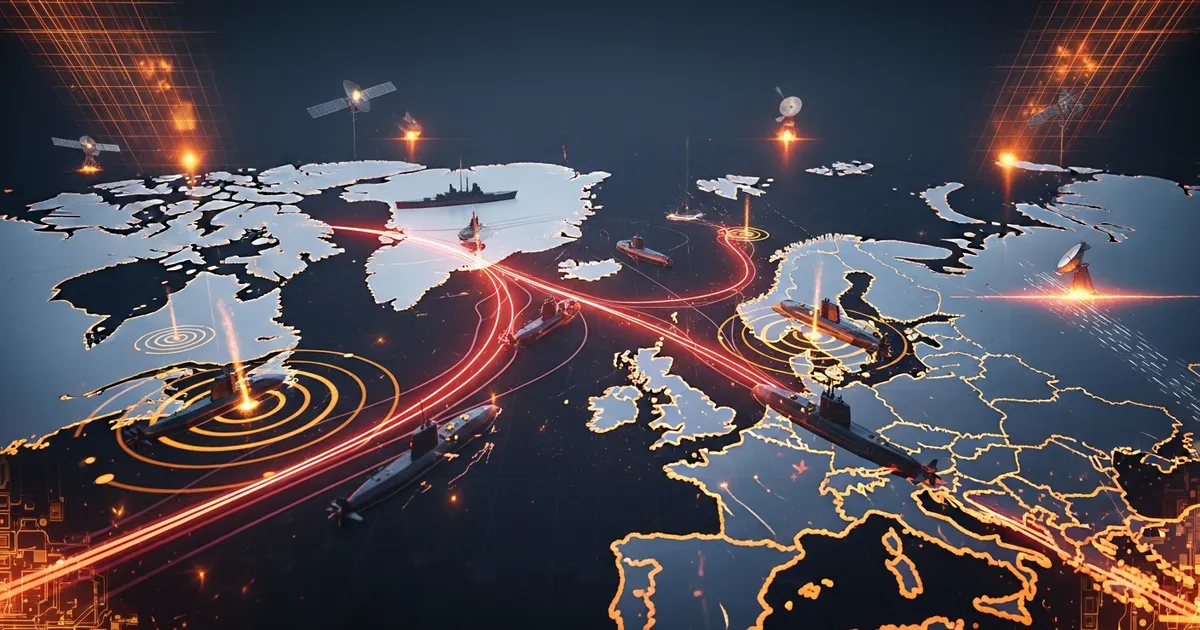
The depths of a new conflict
In a pointed disclosure, the United Kingdom’s Ministry of Defence recently revealed that the Royal Navy had been tracking a Russian attack submarine and specialized deep-sea research vessels engaged in what it termed “nefarious activity” near critical undersea infrastructure. The statement, delivered by Defence Secretary Grant Shapps, pulls back the curtain on a shadowy conflict unfolding on the ocean floor—a struggle over the physical lifelines of our digital world.
The operation involved the Royal Navy frigate HMS Northumberland, a vessel specifically designed for anti-submarine warfare, which detected and shadowed the Russian flotilla. The Russian contingent included not only a combat submarine but also ships from the Main Directorate of Deep Sea Research (GUGI), a secretive and highly capable branch of the Russian Navy. According to a report from The Record, this incident underscores Russia’s persistent interest in the vital arteries that carry over 95% of global internet traffic and trillions of dollars in financial transactions daily.
Technical details of a physical threat
This event is not a cyberattack in the traditional sense; there are no malware signatures or indicators of compromise to analyze. Instead, it represents a physical threat vector aimed at the foundational layer of global connectivity. The “nefarious activity” observed likely falls into several categories of military and intelligence operations.
Reconnaissance and Mapping: The primary goal of such missions is often to build a detailed operational picture of the seabed. Using advanced sonar, remotely operated vehicles (ROVs), and deep-sea submersibles, GUGI vessels can precisely map the routes of fiber optic cables, identify repair junctions, and pinpoint vulnerabilities. This intelligence is invaluable for planning future operations, whether for espionage or sabotage.
Sabotage Preparation: The presence of an attack submarine alongside GUGI’s specialized ships suggests a coordinated effort. These operations could serve as rehearsals for physically disrupting cables. GUGI’s fleet, including its well-known intelligence ship *Yantar*, is equipped with submersibles like the Losharik and unmanned underwater vehicles capable of manipulating objects at extreme depths. They can sever a cable with precision, attach listening devices, or even pre-position explosives for later detonation.
Psychological and Strategic Signaling: By conducting these operations in sensitive areas, Russia sends a clear message to NATO and its allies: we have the capability to cripple your economies and disrupt your military communications at a time of our choosing. This form of hybrid warfare creates ambiguity and anxiety, achieving strategic goals below the threshold of open conflict.
The Main Directorate of Deep Sea Research, or GUGI, is central to these operations. It is not part of the regular Russian naval order of battle and reports directly to the Ministry of Defence, highlighting its strategic importance. Its assets are purpose-built for covert missions on the ocean floor, from retrieving sensitive technology from sunken vessels to surveying and potentially interfering with undersea infrastructure.
Impact assessment: A global vulnerability
The consequences of a large-scale, coordinated disruption of undersea cables would be catastrophic. The impact would extend far beyond slow internet speeds, affecting every facet of modern society.
- Economic Disruption: The global financial system relies on the near-instantaneous transfer of data across these cables. A significant outage could halt international banking, stock market transactions, and credit card payments, triggering immense economic instability.
- National Security: NATO and its member states depend on secure undersea cables for military command and control, intelligence sharing, and diplomatic communications. Severing these lines could blind and isolate military forces during a crisis.
- Societal Impact: From remote work and education to telemedicine and basic communication, modern life is built on the assumption of constant connectivity. Widespread disruptions would cause severe societal dislocation.
This threat is not merely theoretical. The 2022 sabotage of the Nord Stream gas pipelines and the 2023 damage to the Balticconnector pipeline and telecom cable served as stark reminders of the vulnerability of undersea infrastructure. While attribution in those cases remains complex, they demonstrated that state or state-sponsored actors possess both the will and the means to carry out such attacks.
How to protect yourself and our shared infrastructure
Protecting thousands of miles of cable laid across the ocean floor is a monumental challenge. Security requires a multi-layered approach involving governments, private industry, and individuals.
For Governments and Industry:
- Enhanced Surveillance: Nations must invest in maritime patrol aircraft, surface warships, submarines, and new technologies like the UK’s Multi-Role Ocean Surveillance (MROS) ships to monitor critical infrastructure corridors. Publicly disclosing tracking operations, as the UK has done, serves as a form of deterrence.
- Infrastructure Redundancy: Building new, geographically diverse cable routes can mitigate the impact of a single cable cut. Encouraging investment in alternative data-transfer technologies, like satellite constellations, also builds resilience.
- Public-Private Partnerships: Since most cables are owned and operated by private consortiums, close collaboration between naval forces and telecom companies is essential for sharing intelligence and coordinating protection efforts.
For Individuals:
While individuals cannot patrol the North Atlantic, understanding the nature of data security is paramount. The data traversing these fiber optic cables is generally protected by strong, layered encryption. However, security is an end-to-end responsibility. Protecting your data as it travels from your device across various networks is a sound practice. Using tools that provide an encrypted tunnel for your internet traffic, such as a VPN service, adds a personal layer of security to your communications, safeguarding them from interception at vulnerable points along their journey.
Ultimately, the UK’s announcement is a calculated move in an ongoing strategic competition. By bringing these deep-sea maneuvers into the light, the British government is signaling to Moscow that its actions are not going unnoticed. It is a reminder that the contest for information superiority is being waged not only in cyberspace but also in the cold, dark depths of the ocean.